A Prime Minister Simulator Where Every Decision Costs You
Published 30 August 2026 · 4 min read
By Cong Le · Pocket Grove
Sources reviewed: .
Try a government that never gives you a safe answer
Quick answer: A political survival simulator is about balancing competing audiences rather than finding one correct answer. Protecting Cabinet loyalty, backbenchers, media coverage, and public opinion can each create a different cost later in the run.
A political simulation stops being interesting when every problem has an obviously correct answer. The job is not choosing good over bad. It is choosing which cost you can survive.
That is the idea behind Prime Minister Sim. Each decision moves four groups with different interests: your Cabinet, your backbenchers, the media and the public. If any one group loses all confidence in you, the government ends.
Four audiences, no universal approval
A promise that reassures the public may anger MPs who have to vote for it. Protecting a minister may preserve Cabinet loyalty while giving the press another day of scandal. A short-term popularity win can create the crisis that removes you several months later.
The four meters are deliberately not one approval score. You have to notice which relationship is closest to breaking before answering the next card.
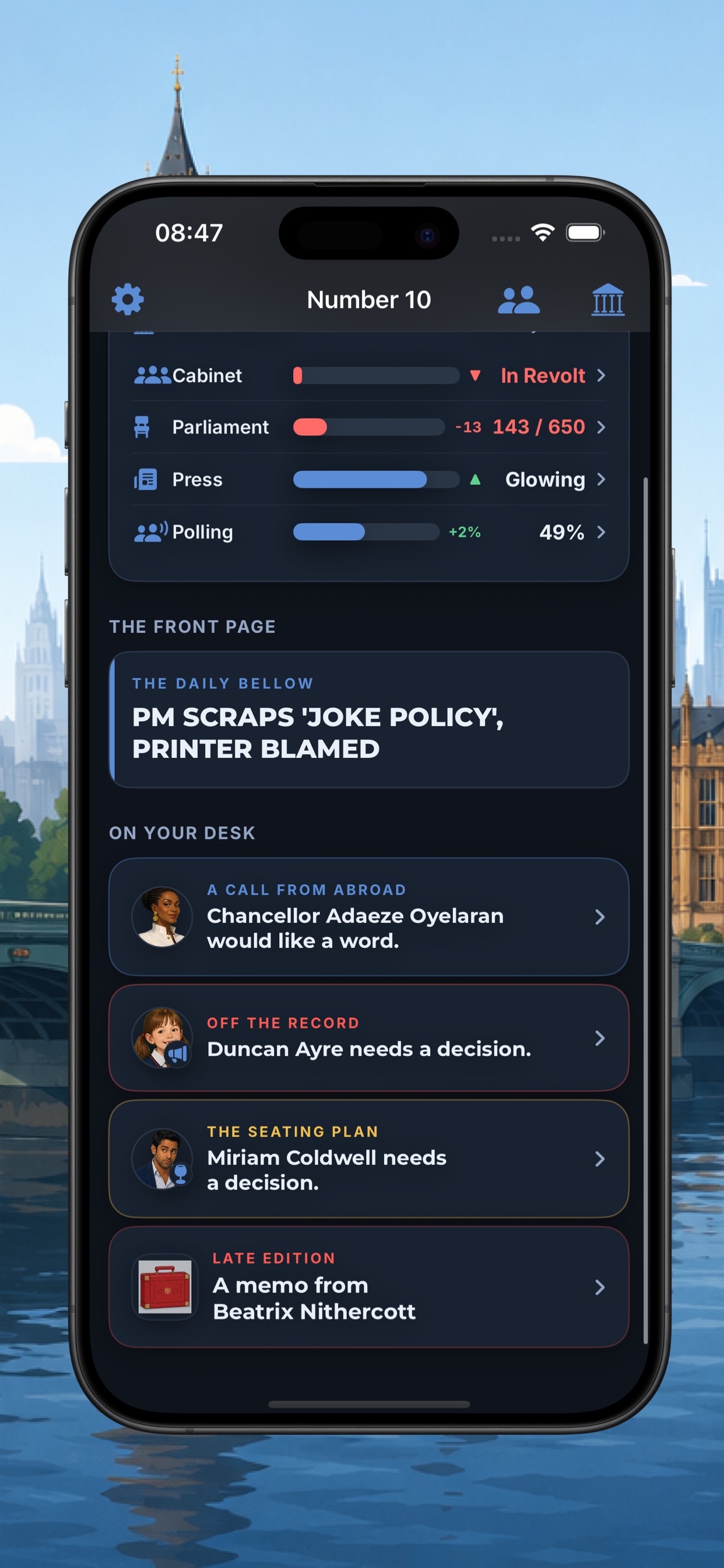
Store screenshot from the Apple listing, reviewed 25 September 2026. It shows the advertised faction pressures; it is not a recorded playthrough or a prediction of a reader's result.
The decisions remember what you did
A choice matters more when it changes what can happen later. Manifesto promises follow you into government. Ministers remember whether you protected or embarrassed them. A rival becomes dangerous when Cabinet loyalty weakens. Elections and second terms carry forward the mess rather than resetting it.
That continuity turns a five-minute run into a story: not just how long you lasted, but the chain of compromises that eventually brought you down.
What makes a run worth replaying
The interesting question after a loss is not simply which answer was wrong. It is which earlier promise made the later answer expensive. A choice that looks generous while approval is high may be impossible once the press, Cabinet, or backbenchers have a reason to oppose you. Replay with a different priority and the same crisis can produce a different route through government. That makes each short run a small experiment in political trade-offs.
A decision review for your next run
After a run ends, write down one decision that helped one group and one cost it created elsewhere. For example:
| Question | Example note |
|---|---|
| Who did the choice reassure? | The Cabinet stayed above the immediate danger line. |
| Who paid the cost? | Backbenchers now have a reason to resist the next vote. |
| What did I promise? | I accepted a short-term headline win that will constrain a later answer. |
| What will I watch next time? | Check the weakest faction before choosing the most popular-looking response. |
These notes are a fictional planning exercise, not a claim that the same values or event sequence will appear in every run. The app's public listing describes four faction meters, crisis cards, PMQs duels and inherited consequences; it does not make real political predictions.
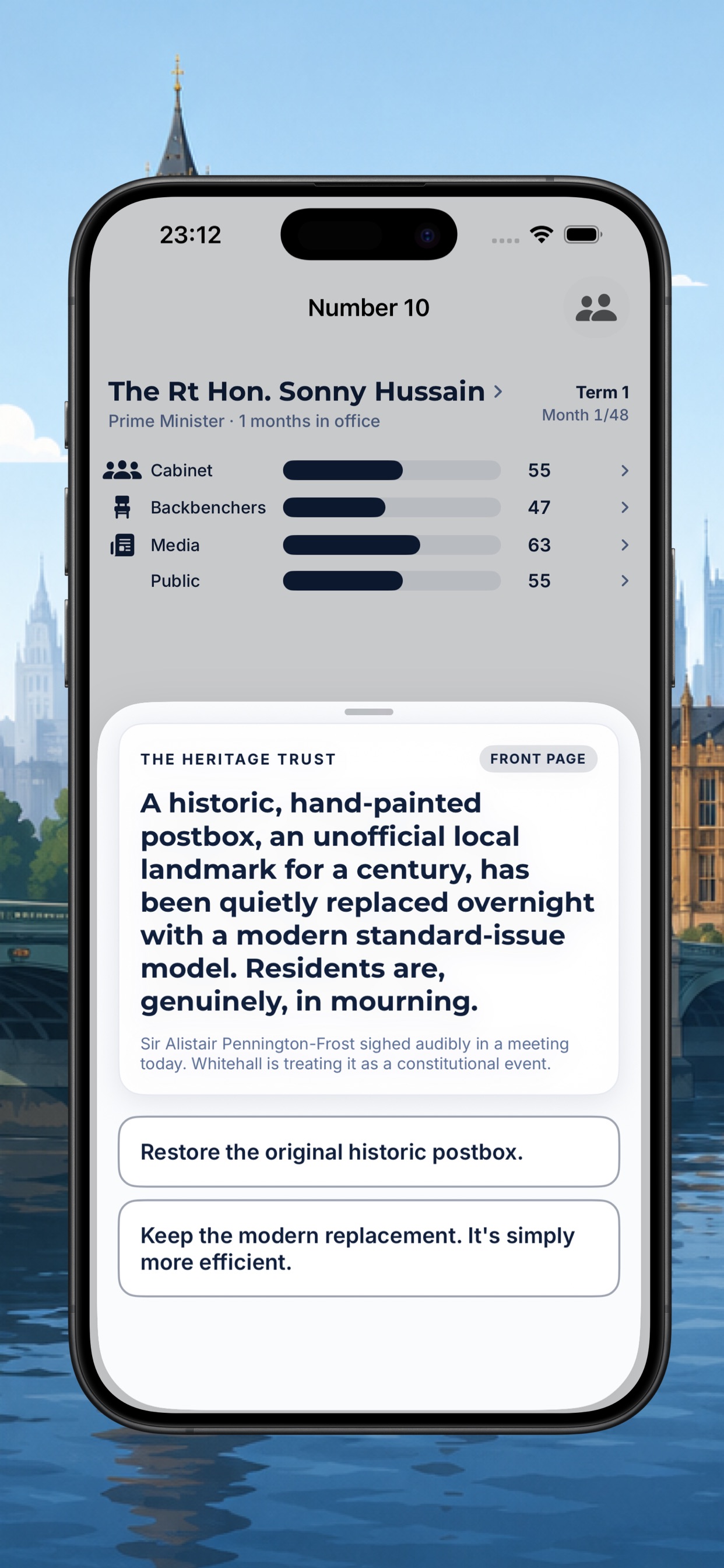
The listing artwork shows a fictional “historic postbox” card with two visible responses: restore the original or keep the modern replacement. The image documents the kind of trade-off presented in the listing; it does not document the faction changes caused by either choice.
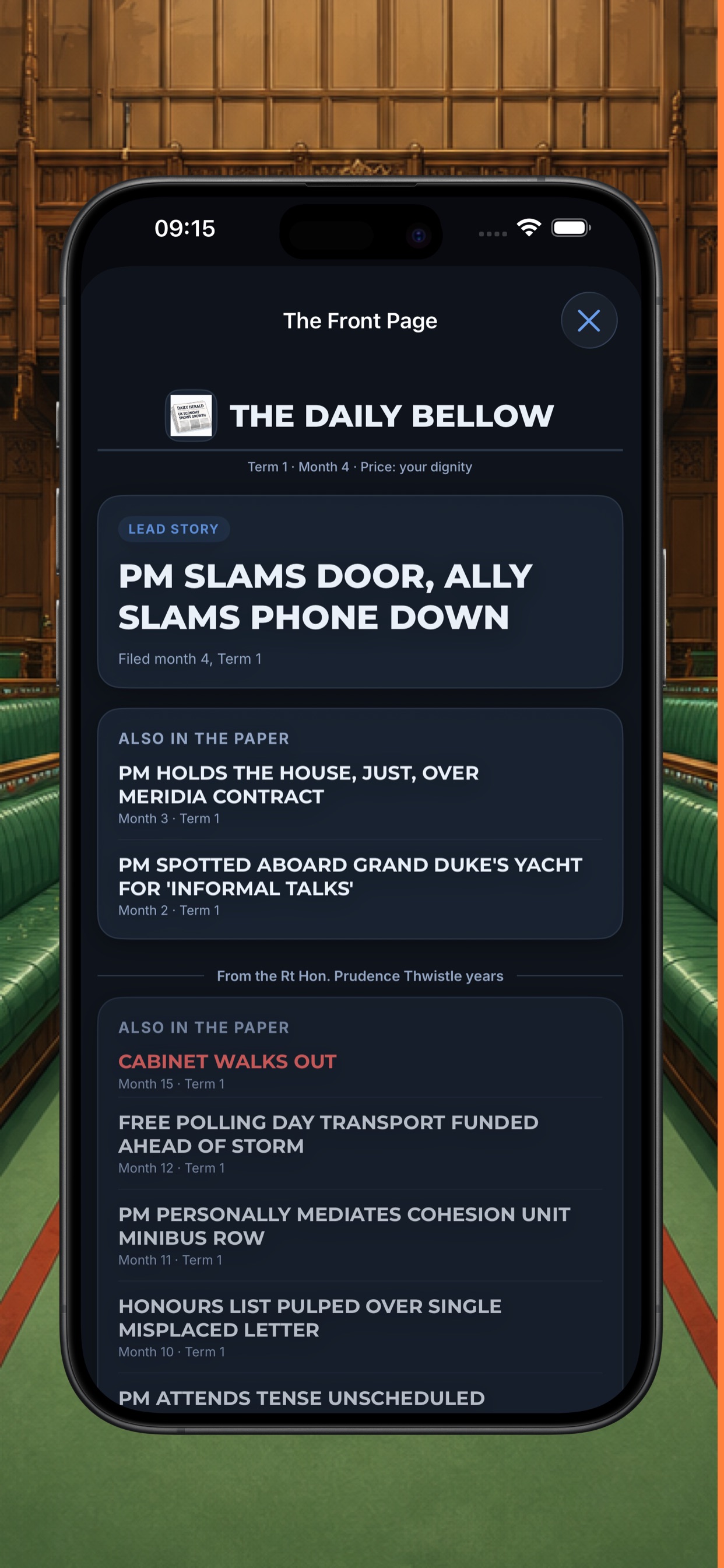
A second listing image shows a “Daily Bellow” history containing earlier fictional headlines, including “Cabinet walks out.” It illustrates continuity and consequences as a product promise; it is not a record of an actual reader's run.
Politics needs specificity to feel alive
The game contains more than 640 hand-written crisis cards spanning scandals, summits, strikes, gaffes and cover-ups. PMQs becomes a duel at the Dispatch Box. You choose which dossiers to carry and how to answer the opposition rather than watching a generic score resolve itself.
The names and events are fictional. The structure is recognisable: factions, headlines, promises, elections and the feeling that somebody is always preparing the next challenge.
Try to outlast the previous government
Prime Minister Sim: Politics is free on iPhone, with the full screenshots and feature breakdown on its Pocket Grove app page. A run can last a few minutes; the difficult part is resisting the immediate answer that creates next month's disaster.
The app behind this guide
Prime Minister Sim: Politics
Prime Minister Sim turns each fictional crisis into a short political survival run with consequences that carry forward.
Related guides
Football Career Mode on iPhone: From Prospect to Retirement
How a player-focused football career mode works on iPhone: training, simulated match decisions, transfers, seasons, and the four-season free start.
Basketball Sim Games vs Arcade Basketball: Which Is for You?
Compare arcade basketball, realistic on-court sims, and career simulators by controls, session length, progression, and play style.
Career Mode Progression Loops: Why They Feel Rewarding
A research-grounded guide to career mode progression: competence, choice, feedback, long-term goals, and what Hoop Quest actually does.